Locally owned and independently operated.

What Is a Furnace Tune-Up & Why It Matters

Picture a furnace tune-up like giving your system a yearly physical — except with fewer awkward questions.

What Happens During a Tune-Up?

Our technicians:
● Inspect and clean major components
● Test safety controls
● Check electrical connections
● Ensure proper airflow
● Confirm efficiency levels
● Look for early signs of failure

Why It’s Important

● Prevents breakdowns
● Keeps your system running efficiently all winter
● Lowers your energy bills
● Extends your furnace’s lifespan
● Protects your warranty
A tune-up is a small investment that saves you big time when the temperatures drop.

Winterization Tips for Your HVAC System

Winter in Missouri likes to show up uninvited… and early. Keeping your home warm doesn’t have to be stressful, though — a little preparation goes a long way.

Quick & Easy HVAC Winterization Tips

  • Change your filter (seriously!) Your furnace can’t breathe through a dirty filter. Changing it often keeps the heat flowing.
  • Clean around the furnace A clean furnace area = better airflow + safer operation.
  • Check your thermostat settings Make sure it switches automatically to heat and that your schedule reflects the cooler months.
  • Keep vents open Closed vents do not save money. They stress your system.

Best Tip of All?

Schedule your fall furnace tune-up to catch little issues before they become big, expensive ones.

HVAC Federal Tax Credits Ending in 2025: Why You Shouldn’t Wait

If you’ve been thinking about replacing your furnace, AC, or upgrading to a heat pump… this is your sign from the HVAC universe (AKA us).
The federal HVAC tax credits created under the Inflation Reduction Act are scheduled to end on December 31, 2025, and that deadline is approaching faster than Missouri winter winds.

What Tax Credits Are Still Available?

Eligible homeowners can still claim up to:

  • $2,000 for installing a qualifying heat pump
  • $600 for a high-efficiency furnace
  • $600 for central AC
  • $150 for a home energy audit

That’s real money back in your pocket — and a more efficient, comfortable home.

Why the Urgency?

  • Equipment is already in high demand.
  • Contractors across the country will be booked solid by fall 2025.
  • These credits will not roll over into 2026 unless the government creates new legislation.

Beat the rush. Avoid the last-minute scramble. And lock in those savings before 12/31/2025.

Have questions? We love questions.

info@level9hvac.com

How to Clean Your Air Conditioner at Home

How to Clean Your Air Conditioner at Home (and Why You Should!)

Your air conditioner works hard to keep your home comfortable—especially during the hottest months of the year. But like any hard-working system, it needs a little attention to keep it running efficiently.

One of the simplest ways to improve your AC’s performance, extend its lifespan, and lower your energy bills? Regular cleaning. Here’s a step-by-step guide to safely clean your air conditioning system at home.

???? Important Note: This guide is for central air conditioners. If you’re unsure or uncomfortable doing any part of this yourself, always call a licensed professional.

???? Tools You May Need:

  • Screwdriver
  • Garden hose with spray nozzle
  • Fin comb (optional, for straightening bent fins)
  • Vacuum with a soft brush attachment
  • Mild dish soap or coil cleaner
  • Gloves and safety goggles

Step 1:

Turn Off Power to the System

Before doing anything, make sure the power is off at the thermostat and the breaker box. This ensures your safety while working near electrical components and moving parts.

Step 2:

Clean or Replace the Air Filter

Your air filter is the first line of defense against dirt and dust—and a clogged filter can restrict airflow and strain your system.

  • Where to find it: Usually behind a return vent, inside the air handler, or at the base of the furnace.
  • How often to change it: Every 1–3 months depending on usage, pets, and allergies.

???? Pro Tip: Set a recurring reminder on your phone to check it monthly.

Step 3:

Clear Debris from the Outdoor Unit (Condenser)

Leaves, grass, dirt, and even mulch can build up around your outdoor unit, blocking airflow.

  • Use your hands or a shop vacuum to remove large debris from the top and sides.
  • Trim back any vegetation or landscaping to leave at least 2 feet of clearance around the unit.

Step 4:

Clean the Condenser Coils

Over time, dirt and grime can coat the coils, reducing your AC’s efficiency.

  • Remove the top cover (usually secured with screws).
  • Spray the outside fins gently with a garden hose from the inside-out (never pressure wash—this can damage delicate fins).
  • Use a coil cleaner or mix of dish soap and water for stubborn gunk. Let it sit, then rinse.

⚠️ Avoid getting water directly on the electrical components inside the unit. Let it dry completely before restoring power.

Step 5:

Straighten the Coil Fins (Optional)

Bent fins can restrict airflow. Use a fin comb (available at hardware stores) to gently straighten them. Be cautious—they’re sharp and fragile.

Step 6:

Vacuum the Indoor Unit

Inside your home, locate the indoor air handler or furnace blower compartment.

  • Remove dust buildup using a vacuum with a soft brush.
  • Wipe down accessible components.
  • If you notice excessive dirt or mold, call in a professional for a deeper cleaning.

Step 7:

Check Your Thermostat Settings

After cleaning, make sure your thermostat is set to cool and that the fan operates properly. Replace batteries if needed.

✅ Bonus: Schedule a Professional Tune-Up

While regular cleaning goes a long way, a professional HVAC tune-up includes:

  • Refrigerant level check
  • Electrical inspection
  • System calibration
  • Deep cleaning of hard-to-reach components

This ensures your system stays in top shape and avoids surprises when you need it most.

????️ Why Cleaning Matters

  • Efficiency Boost: Clean systems don’t work as hard to cool your home.
  • Lower Energy Bills: Better airflow = less energy used.
  • Fewer Repairs: Dirt and neglect are leading causes of AC breakdowns.
  • Longer Equipment Life: A little care now can save you thousands in the long run.

???? Not Sure or Don’t Want to DIY?

That’s what we’re here for! Whether it’s a one-time cleaning or routine preventative maintenance, our team can make sure your system is running smoothly, safely, and efficiently—so you don’t have to lift a finger (or a fin comb). Just call (636) 266-2509  today!

How to Prepare Your Home (and Heart!) for the Heat Wave Ahead

Tips from Level 9 Heating, Cooling & Plumbing to Keep You Cool, Safe, and Supported

Summer heat is coming in strong, and at Level 9, we want to make sure your air conditioner—and your family—are ready for it. Whether you’re staying inside or working outdoors, a little prep can go a long way to protect your comfort, your energy bill, and your well-being.

???? Quick Home Tips to Keep Your AC Running Efficiently:

1. Clear off your outdoor AC unit

Grab a hose and gently rinse off your outdoor unit to remove leaves, grass clippings, and dirt. A clean unit breathes better and cools your home faster (and more efficiently).

2. Replace your air filter

Dirty filters restrict airflow and make your system work harder. A fresh filter can lower your energy use and help your AC keep up with rising temps. If it’s been over 30–60 days—swap it out now.

3. Keep vents open and unblocked

Make sure furniture, rugs, or toys aren’t covering your indoor vents. Your system is designed for balanced airflow throughout your home.

4. Close blinds during peak sun hours

Blocking direct sunlight helps your AC work less and keeps your space cooler naturally—especially in rooms that get full afternoon sun.

5. Use fans to support your system

Ceiling fans and box fans help circulate the cool air your AC is creating. Bonus: running them counter-clockwise helps push cool air downward.

If your system still struggles, or if something doesn’t seem right—don’t wait until it stops completely. Our team is just a phone call away and ready to help.

???? Call Level 9 at (636) 266-2509

It’s Not Just About Comfort—It’s About Community

At Level 9, we care deeply about the families and neighborhoods we serve. During extreme heat, please take a moment to check on your elderly neighbors, loved ones, and anyone who may not have working AC. A quick call or visit could mean everything.
And don’t forget the pets! Make sure outdoor animals have plenty of fresh water and shaded areas to stay cool.

For your own safety:

● Stay hydrated—drink plenty of water

● Avoid outdoor work during peak heat (typically 1–5 PM)

● Take regular breaks in the shade or inside

● Never leave children or pets in parked vehicles

We’re all in this together, and we’re here for you—whether it’s a quick AC check-up, an emergency repair, or just a neighborly reminder to take care.

Stay safe, stay cool, and call us if you need anything.


Level 9 Heating, Cooling & Plumbing
???? Proudly serving Washington, MO to St. Louis and surrounding areas
???? (636) 266-2509
???? www.level9hvac.com

Changes to air conditioner regulations beginning in 2025

[St. Louis, Missouri] — Homeowners are facing significant price increases to their home comfort
as the Environmental Protection Agency (EPA) prepares to implement sweeping changes to air
conditioner regulations beginning in 2025. These new regulations require air conditioner
manufacturers to move away from refrigerants currently in use to mitigate the environmental
impact of running a heating and cooling system. Although this sets the course for a more
environmentally-friendly future in home comfort, the changes are also expected to lead to a
staggering increase in installation costs, projected to rise by 10-25% on January 1, 2025, as
HVAC manufacturers implement the new technology.

Adding urgency to this situation, Ameren Missouri has announced that it will not continue its
rebate program in 2025, which has historically provided crucial financial support to
homeowners. Previously, rebates ranged from $450 to $1,300, assisting many in managing the
costs associated with replacing aging HVAC systems. Without this financial assistance, many
homeowners may find themselves unprepared for the financial burden of upgrading their
systems in 2025.

“This is a crucial moment for homeowners to stay informed and strategize their home comfort
investments,” said Kyle Brittingham, President at Level 9 Heating Cooling and Plumbing. “With
the impending changes and the loss of rebates, it’s essential for families to plan ahead and
explore their options.”

A heating and cooling system has an expected lifespan of 10-15 years, so homeowners with
aged heating and cooling systems are encouraged to act promptly and consider their needs
before the 2025 price increases take effect. Homeowners who replace their HVAC system
before December 31, 2024, can take advantage of the opportunities to save money that are still
available, including Ameren’s rebate program. For more information about the new HVAC
regulations, tips on how to navigate these changes, or a free estimate for a new system, please
contact Level 9 Heating Cooling and Plumbing at (636) 239-3581.

For media inquiries, please contact:
Abby Poetz
Marketing Director
Level 9 Heating Cooling & Plumbing
(636) 649-0022


CITED SOURCES:
EPA regulations will no longer allow heating and cooling equipment refrigerants with a Global
Warming Potential (GWP) over 700 to be installed after January 1 2025

R410A, the most common refrigerant for residential heating and cooling systems, does not meet
EPA regulations beginning in 2025

HVAC manufacturers will update their new equipment to utilize an EPA-compliant refrigerant,
which will be accompanied by a rise in price due to the new technology.

    Ameren Missouri will discontinue their rebate program in 2025

  • Ameren Missouri Heating and Cooling Program. “HVAC Rebate Program to End 12/31/24” . Received by Chunn, Rachael. (2024, October 17).

Ameren Missouri Heating & Cooling Program Will End December 31, 2024

We regret to announce that the Ameren Missouri Heating and Cooling Rebate Program will end on December 31, 2024. Starting next year, rebates will no longer
be available for the purchase and installation of air conditioners, air source heat
pumps, ground source heat pumps or smart thermostats through this program.

For over 11 years, the Heating and Cooling Program has helped make energy-efficient
HVAC upgrades more affordable, allowing Ameren Missouri customers to save energy
and money.

Ameren Missouri made a filing with the Missouri Public Service Commission to
continue the Heating and Cooling Rebate Program along with other residential energy
efficiency programs. However, during the proceeding, Ameren Missouri’s proposal to
continue the Heating and Cooling Program did not receive the level of support needed
to continue. As a result, a stipulation and agreement for Ameren Missouri’s energy
efficiency plan will be filed with the Missouri Public Service Commission, leading to the
end date of the Heating and Cooling Program in 2025.

We are extremely grateful to you, our contractors and distributors. Your participation
has been essential in making the program a tremendous success, and this happening
is in no way an indication of your hard work, diligence and hugely positive impact for
more than a decade. We are immensely thankful for your partnership!

While we do not know if the program will return in the future, Ameren Missouri remains
committed to working with the Missouri Public Service Commission to offer energy
savings programs to Ameren Missouri customers. Customers who are interested in
current opportunities should visit AmerenMissouriSavings.com.

Important Deadlines

As we approach the end of the year and the end of this current program, please
remember to submit your applications in a timely manner and keep these deadlines
in mind:

  • December 16, 2024 – Applications due for all installations completed through
    November 30, 2024.
  • December 31, 2024 – Final day to submit 2024 applications.
    • Any 2024 applications received after December 31, 2024, at 6:00 p.m. will
      NOT be processed.

    If you have any questions, please contact your account manager.

    The Ameren Missouri Heating and Cooling Program Team

Have You Been Considering Replacing Your Air Conditioner or Furnace?

There are some changes coming up that could impact your decision

Homeowners whose air conditioners may be getting older should start to consider their options before the end of the year. Beginning January 1, 2025, the cost to install a new heating and cooling system is expected to rise by at least 10%. Additionally, opportunities to save on a new system will be harder to find in 2025 as fewer rebate programs and tax credits are available.

WHAT DOES THIS MEAN TO ME?

Homeowners should evaluate how old their current air conditioner system is. If a system should be replaced within the next few years, there are a few options available:

  1. Replace the System Before the End of 2024: Replacing a system now enables a homeowner to take advantage of the current style of air conditioners that are more affordable, and the rebate programs that are still available.
  2. Wait to Replace the System Until 2025 or Later: Homeowners who wait to replace their system will enjoy a more environmentally friendly air conditioner, but installation will cost at least 10% more, and there will be fewer opportunities to save money, such as rebates or tax credits.

Call Us Today

HOW DO I KNOW IF MY SYSTEM IS OLD?

A well-maintained heating and cooling system has a life expectancy of 10-15 years. A homeowner should start to consider their options when their system is over 8 years old, especially if it has started to show signs of decline.

WHAT SHOULD I DO IF MY SYSTEM IS OLD?

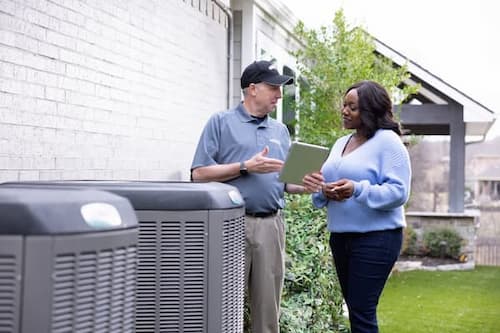
AC Unit being Discussed with Homeowner

Homeowners with aging heating and cooling systems should contact their local HVAC company for information about how to prepare for the 2025 cost increases. An HVAC provider can help create a customized plan to suit each individual’s unique situation. They may offer to replace a system while opportunities to save money are still available, or they can help determine if it is in a homeowner’s best interest to maintain their existing system.

WHY ARE PRICES INCREASING?

The Environmental Protection Agency (EPA) is implementing new regulations in 2025 that will change the way air conditioners are made. The new standards are aimed at making air conditioners more environmentally friendly*, setting the course for a brighter and healthier future for our planet. However, the new technology will come with a rise in price, increasing the cost for a new system by at least 10%.**

WHAT REBATE/TAX CREDIT PROGRAMS ARE AVAILABLE?

Ameren Missouri, a local utility provider, currently has rebates available ranging from $450 to $1,300 to customers who use their services. This program, which has assisted homeowners for over a decade, will not be available in 2025.***

Additionally, the Energy Efficient Home Improvement Credit (25C T ax Credit) can save a homeowner anywhere from $600 to $2,000 when they install a new system.**** The tax credit will still be available in 2025, but the standards for a system to qualify will be higher. ***** This means that a homeowner will need to purchase a higher efficiency system to meet the requirements for the tax credit in 2025. Typically, the cost for a heating and cooling system rises as efficiency increases, meaning a homeowner can expect to pay more for a system that qualifies for the tax credit in 2025.

CONTACT YOUR HVAC PROVIDER TODAY FOR MORE INFORMATION

If you have any questions or would like help considering your options, please contact your preferred heating and cooling company. In the St. Louis area, Level 9 Heating Cooling and Plumbing is knowledgeable, professional, and eager to help you navigate these changes. Our staff is ready to answer questions, or to provide you with a free estimate for replacement.

Contact the Level 9 office today for answers and assistance.

Call Today for Assistance

The Role of HEPA Filters in Air Purification

Air filters are devices that trap airborne particles. These are particles that can exacerbate allergy and asthma symptoms and even present more serious health hazards with extended exposure. By removing them, you improve indoor air quality and promote a healthier environment. HEPA filters are a particular type of air filter used in many air purification systems.

What Is a HEPA Filter?

HEPA is an acronym that stands for high-efficiency particulate air. In the U.S., the Department of Energy (DOE) established and maintains the standard for HEPA filters. HEPA filters are a style of pleated filter. These are filters made from cloth, paper or a similar material. The manufacturer folds that material into a series of pleats in order to increase surface area. The industry commonly uses pleated filters for central HVAC systems and for portable and fixed air purifiers. A HEPA filter will trap at least 99.97% of particles that pass through it. The DOE measures air filters based on minimum performance. You can think of this effectiveness as 99.97% or better.

The History of HEPA Filters

The U.S. Army Chemical Corps and National Defense Research Committee developed the original HEPA filter as a joint project. This project was part of the larger Manhattan Project in the 1940s. The mission of the Manhattan Project was the development of nuclear weapons. The lab in Oak Ridge, Tennessee needed an air filter that would protect the more than 90,000 workers there. From that need, the HEPA filter was born.

The industry didn’t coin the term high-efficiency particulate air until the 1950s. This is when the U.S. declassified the technology, and it became commercialized. HEPA was a generic trademark. Shortly after, HEPA filters were in use in many hospitals and in air purifiers for homes. By the 1960s, HEPA was the filtration standard for the microelectronics and nuclear power industries. More than 80 years after its invention, HEPA remains the standard for mechanical air filtration.

How Does an HVAC Filter Work?

The core material used for HEPA filters is a mat of fibers. The manufacturer weaves those fibers in a random arrangement. The pleated form factor expands the surface area, but it’s the web-like arrangement of fibers that catches the particles. It does this through three main mechanisms: interception, impaction and diffusion.

Interception is when particles in the air bump into a fiber and stick to it. This can occur on the surface of the HEPA filter but also within the web of fibers. Impaction is when a particle penetrates a fiber and becomes embedded. Particles that are 0.1 microns and smaller are not prone to interception and impaction if they have a direct path. This is where diffusion comes in. The web of fibers delays those molecules. The longer they’re delayed, the greater the chance that interception or impaction occurs.

The 0.3-Micron Benchmark

HEPA filters can trap at least 99.97% of airborne particles that are equal to 0.3 microns in size but also smaller and larger. A HEPA filter is actually more effective than 99.97% at trapping smaller particles, such as viruses, which average 0.1 microns. This may seem counterintuitive at first, but it originates with the Manhattan Project. Irving Langmuir was an American chemist, physicist and engineer who identified the 0.3-micron-diameter particle as the most difficult to capture. This became the basis for how we measure air filters and later for the minimum efficiency reporting value (MERV) scale.

MERV Rating

The MERV scale indicates the minimum performance of an air filter to trap particles between 0.3 and 10.0 microns in size. The scale ranges from 1 to 16. In the MERV 1-7 range, a filter can trap particles between 3.0 and 10.0 microns. Starting at MERV 9, air filters can trap particles as small as 1.0 microns. Starting a MERV 11, air filters trap particles as small as 0.3 microns. At MERV 16, an air filter provides 95% or better efficiency trapping particles 0.3 microns and larger.

As mentioned, HEPA filters provide 99.97% effectiveness trapping particles in the 0.3-micron range. This is beyond the MERV scale. Some brands will indicate this as MERV 17-20, but these aren’t official ratings. The DOE and American National Standards Institute (ANSI) don’t recognize those additions. Neither does the American Society of Heating, Refrigerating and Air-Conditioning Engineers (ASHRAE), which developed and maintains the MERV scale.

What’s the Difference Between True HEPA and Other Labels?

It’s important to understand that there’s no official HEPA certification in the U.S. There are three main organizations that test HEPA filters, including the aforementioned ASHRAE. The others are the American Society for Testing and Materials (ASTM) and the Institute of Environmental Sciences and Technology (IEST). Many of the leading brands will indicate that their products meet ASHRAE, ASTM and IEST standards in addition to DOE standards.

You may encounter labels like True HEPA, Absolute HEPA and HEPA Type. These are all marketing labels. That said, the industry uses True HEPA to indicate filters that conform to DOE standards. When shopping filters from reputable brands, you can generally rely on it. Absolute HEPA is generally unreliable as a designation. Permanent HEPA means the product is washable, which most experts advise against. Labels like HEPA Type and HEPA Like are largely meaningless.

Applications for HEPA Filters

HEPA filters are widely used in both portable and whole-house air purification systems. The exception would be air purifiers that don’t use mechanical filtration, such as ionizers. HEPA is generally not recommend for HVAC. Most HVAC systems support up to MERV 13. Beyond that, the air resistance is too great and leads to inefficient operation and increased equipment wear. Many vacuums use HEPA filters or HEPA bags. This ensures that the vacuum traps the dust and other particles rather than recirculates it.

What Can’t a HEPA Filter Trap?

HEPA filters are highly effective at trapping particulate matter. That includes dust, pollen, pet dander, textile fibers and even smoke. Two concerning pollutants that a HEPA filter doesn’t trap well are volatile organic compounds (VOCs) and ozone (O3). VOCs are a carcinogen that off-gases from building products and exist in many cleaning and beauty products. O3 is a naturally occurring gas but one that reacts with VOCs to make it even more dangerous. It does this by making VOCs smaller and better able to penetrate our lungs. Both VOCs and O3 tend to bounce off HEPA fibers rather than stick to them. Many air purifiers will include an activated charcoal stage to absorb VOCs and other gases and airborne particles.

Would You Like to Upgrade Your Home With HEPA Filtration?

Level 9 Heating & Cooling installs HEPA air purifiers throughout Des Peres, St. Louis, Washington and the surrounding areas. Our team also specializes in hydroxyl-based air purification and whole-house dehumidifiers and humidifiers. Our NATE-certified HVAC technicians install and service all manner of heating and cooling technologies, including geothermal heat pumps.

We’re available 24/7 for emergency repairs and offer a maintenance plan that can save you money and time. We have plumbers that specialize in camera inspections, piping and repiping water, sewer and gas lines, drain cleaning and leak detection. Our plumbers also install tank and tankless water heaters, garbage disposals, sump pumps, boilers and water filtration and softening systems.

Call today or contact us online with questions or to schedule an appointment.

Book Online

"*" indicates required fields

This field is for validation purposes and should be left unchanged.